Dr. Alejandro Sánchez highlighted the need to strengthen the integration of knowledge across disciplines and promote educational approaches that address the region's social, scientific, and environmental challenges.
Dr. Alejandro Sánchez, coordinator of the Centro Anáhuac de Desarrollo Estratégico en Bioética (CADEBI), participated in the IV International Congress on Ethics and Bioethics: Interdisciplinarity for Sustainability, organized by the Faculty of Medicine of UNAM, with the presentation “The Interdisciplinary Perspective in Bioethics Education in Latin America.” During his presentation, he shared the initial findings of a research project aimed at examining the characteristics of postgraduate educational programs in bioethics and their approaches to interdisciplinarity and transdisciplinarity.
The research is part of a broader study on bioethics education models developed by higher education institutions and academic centers across Ibero-America, with particular attention to how they integrate knowledge, methodologies, and perspectives from different disciplines.
The Interactive Atlas as a Research Tool
During his presentation, Dr. Sánchez introduced the Observatorio Iberoamericano de Bioética (ORIBI) and its Interactive Atlas, a platform that enables users to access and systematically organize information on academic institutions, educational programs, bioethics organizations, specialized publications, and regulatory frameworks throughout the region.
The study drew on records available in the Atlas, supplemented by a review of the official websites of educational institutions. A categorical qualitative analysis was subsequently conducted to examine the characteristics and educational orientations of the programs.
Preliminary findings identified 10 doctoral programs in bioethics located in Brazil, Colombia, and Mexico, as well as 49 master's program records distributed across several Latin American countries. At both educational levels, in-person instruction remains the most common format, followed by hybrid and online modalities.
From Multidisciplinarity to the Integration of Knowledge
One of the central arguments of the presentation was the importance of distinguishing between the participation of multiple disciplines and their genuine integration within educational processes.
Drawing on theoretical contributions from scholars such as Edgar Morin, Basarab Nicolescu, and Rolando García, the research examines different forms of knowledge organization and integration: disciplinary, multidisciplinary, interdisciplinary, and transdisciplinary approaches. These categories provide a framework for understanding how bioethics education is structured, without establishing a hierarchical ranking of program quality.
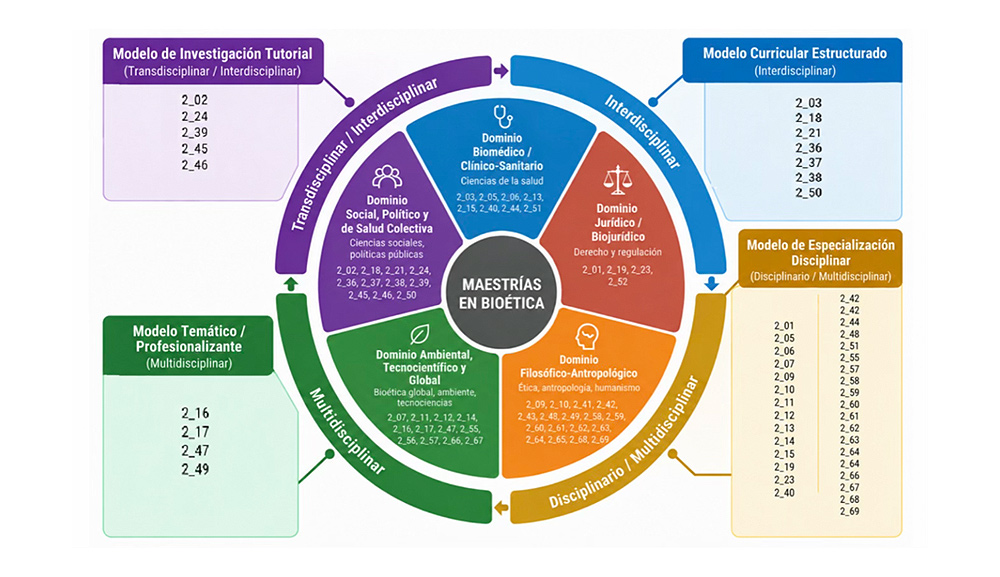
The analysis of master's programs identified five broad domains of academic orientation: biomedical and clinical-healthcare; legal and biolaw; philosophical-anthropological; social, political, and collective health; and environmental, technoscientific, and global.
Two distinct trends in curricular organization were also identified. The first, referred to as additive multidisciplinarity, brings together content from different fields of knowledge, such as medicine, law, and philosophy, without necessarily establishing methodological integration among them.
The second, described as integrative interdisciplinarity, promotes systematic dialogue among disciplines and the development of shared conceptual and methodological frameworks to understand and address complex bioethical problems.
This distinction is particularly significant because the presence of faculty members or students from different disciplinary backgrounds does not, in itself, guarantee interdisciplinary education.
Toward a Bioethics Education That Addresses Contemporary Challenges
The findings also reveal that postgraduate bioethics education in Latin America presents a heterogeneous landscape in which different academic and professional perspectives converge.
On the one hand, a technical-clinical and institutional orientation can be identified, focusing on healthcare-related ethical dilemmas, the work of hospital ethics committees, and biolaw analysis. On the other hand, a sociocritical, environmental, and transdisciplinary orientation broadens the field of study to include collective health, human rights, social equity, global justice, and sustainability.
In this context, the presentation highlighted the potential of transdisciplinary approaches to transcend traditional boundaries of knowledge and incorporate academic, institutional, community-based, and local perspectives. One example is the One Health paradigm, which recognizes the interdependence of human, animal, and environmental health.
From this perspective, the future of bioethics education in the region will depend not only on the diversity of disciplines represented in academic curricula, but also on their ability to develop shared methodologies, foster intercultural dialogue, and promote research grounded in Latin American realities.
Strengthening Research and Regional Cooperation
During the question-and-answer session and subsequent discussion with attendees, participants addressed the importance of continuing to examine the evolution of postgraduate programs, particularly doctoral programs, as well as strengthening educational models capable of responding to contemporary challenges through critical, interdisciplinary, and context-sensitive approaches.
CADEBI's participation provided an opportunity to share progress on an ongoing research project and reaffirm the importance of generating systematic knowledge about bioethics education in Latin America.
Finally, the academic community was invited to explore and use the Ibero-American Interactive Bioethics Atlas, an open-access tool available through email registration that helps increase the visibility of existing initiatives and encourages collaboration among institutions and specialists.
Through this work, CADEBI reaffirms its commitment to strengthening research, education, and academic cooperation in bioethics, promoting approaches that bring together scientific rigor, social justice, intercultural dialogue, and the sustainability of life.
Online transmision
More information:
Centro Anáhuac de Desarrollo Estratégico en Bioética (CADEBI)
Dr. Alejandro Sánchez Guerrero
alejandro.sanchezg@anahuac.mx