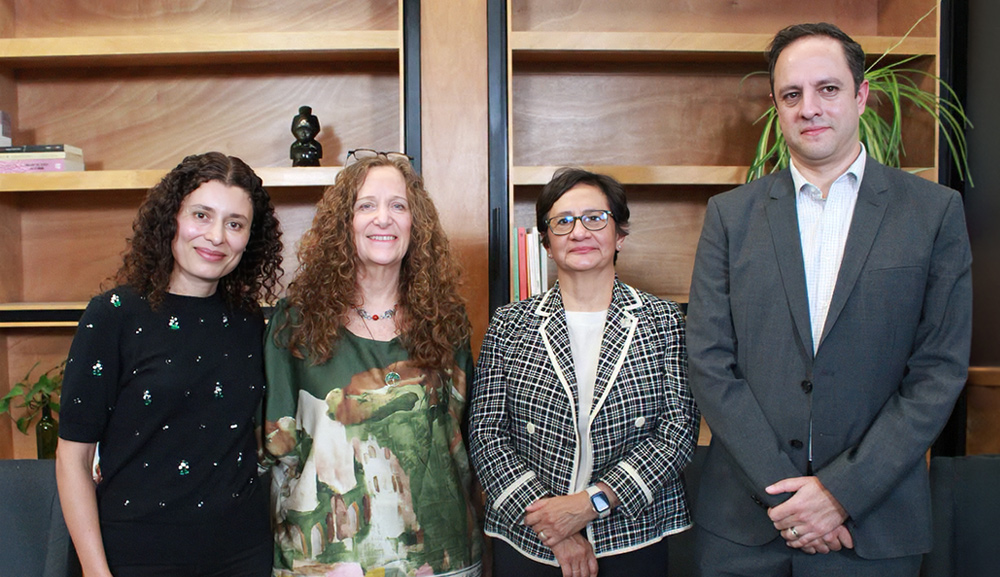
The lecture, delivered by Dr. Dafna Feinholz, addressed autonomy, privacy, consent, justice, and human rights in the face of advances in brain technologies.
The rapid development of neuroscience and technologies capable of recording, interpreting, or modifying brain activity presents unprecedented opportunities for medicine and research, while also raising fundamental questions regarding autonomy, privacy, consent, and the protection of human rights. In this context, bioethical discussion plays a central role in anticipating the risks that may accompany these new tools and in establishing criteria for their responsible development and use.
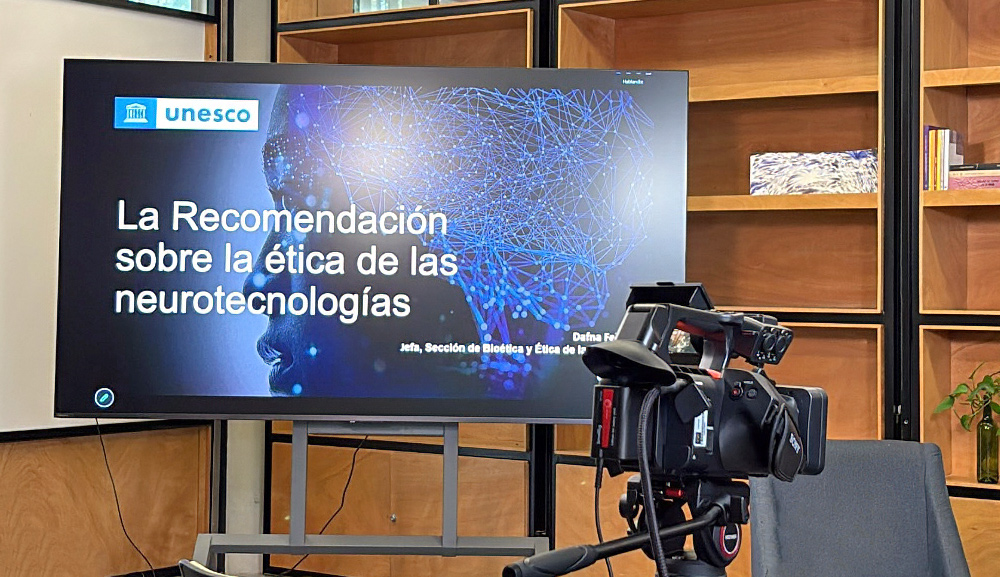
Against this backdrop, on August 11, members of the Anáhuac Center for Strategic Development in Bioethics (CADEBI) attended the conference “Recommendation on the Ethics of Neurotechnology,” delivered by Dr. Dafna Feinholz, who currently serves as Chief of the Bioethics and Ethics of Science and Technology Section at UNESCO. The conference, held at the Faculty of Philosophy and Letters of the National Autonomous University of Mexico (UNAM), addressed some of the main ethical challenges arising from the development and use of neurotechnology, particularly when these tools extend beyond strictly medical applications.
One of the central issues discussed was the need to ensure appropriate informed consent processes, especially in relation to technologies capable of accessing information associated with brain activity and other highly sensitive data. The importance of examining who has access to these technologies, who benefits from them, and under what conditions they are distributed was also emphasized. Inequalities in their availability may deepen existing disparities among different groups and populations, making justice and equity indispensable elements of any regulatory framework, particularly when considered from a bioethical perspective.
The participation of Dr. Dafna Feinholz brought a particularly relevant perspective to the dialogue. Her extensive experience in bioethics, research ethics, human rights, and the ethics of science and technology, as well as her involvement in the processes related to the development of the recommendation, made it possible to address not only its content, but also the challenges that motivated its development and the importance of establishing principles capable of accompanying the evolution of neurotechnology. This provided participants with a privileged perspective and the opportunity to address questions directly with one of the key figures behind the recommendations presented.
The conference also served as the inaugural session of the Seminario Extraordinario de Problemas Bioéticos Contemporáneos de la UNAM, coordinated by Dr. Carol Hernández Rodríguez, a forum that will continue to address a range of contemporary bioethical issues through the participation of national and international specialists. Also participating in this first session were Dr. María Teresa Torres Guzmán, Director of the Institute of Neurobiology at UNAM, and Dr. Luis B. Tovar y Romo, Director of the Institute of Physiology at UNAM. Their contributions enriched the discussion from their respective areas of expertise, providing a multidisciplinary panel that brought together perspectives from bioethics, neuroscience, and physiology.

For CADEBI, these forums represent an opportunity to strengthen interdisciplinary dialogue and build valuable relationships with institutions and specialists dedicated to studying the challenges posed by science and technology, while emphasizing the importance of consistently incorporating a bioethical perspective. At the conclusion of the conference, members of CADEBI had the opportunity to present Dr. Feinholz and Dr. Hernández Rodríguez with some of the projects currently being developed by CADEBI, share the book Bioética y Derecho, and invite them to participate in the activities of the Bioethics Research Observatory (ORIBI).
Neurotechnology requires bioethics to anticipate scenarios and technologies that, until only a few years ago, seemed beyond reach. The possibility of accessing brain activity with increasing precision represents more than a scientific advancement: it also raises questions about what information belongs to a person’s most intimate sphere, who may access it, and what limits should govern its use. In the face of these challenges, dialogue among science, technology, law, and bioethics will be essential to ensure that innovation advances in a manner compatible with human dignity and human rights.
CADEBI extends its gratitude to the National Autonomous University of Mexico for the invitation to this event and reaffirms its interest in continuing to participate in spaces for academic dialogue that bring emerging issues of bioethical relevance closer to the community and contribute to their discussion from an interdisciplinary perspective.

* Photos taken from Programa Universitario de Bioética's Facebook page.
More information:
Centro Anáhuac de Desarrollo Estratégico en Bioética (CADEBI)
Dr. Alejandro Sánchez Guerrero
alejandro.sanchezg@anahuac.mx