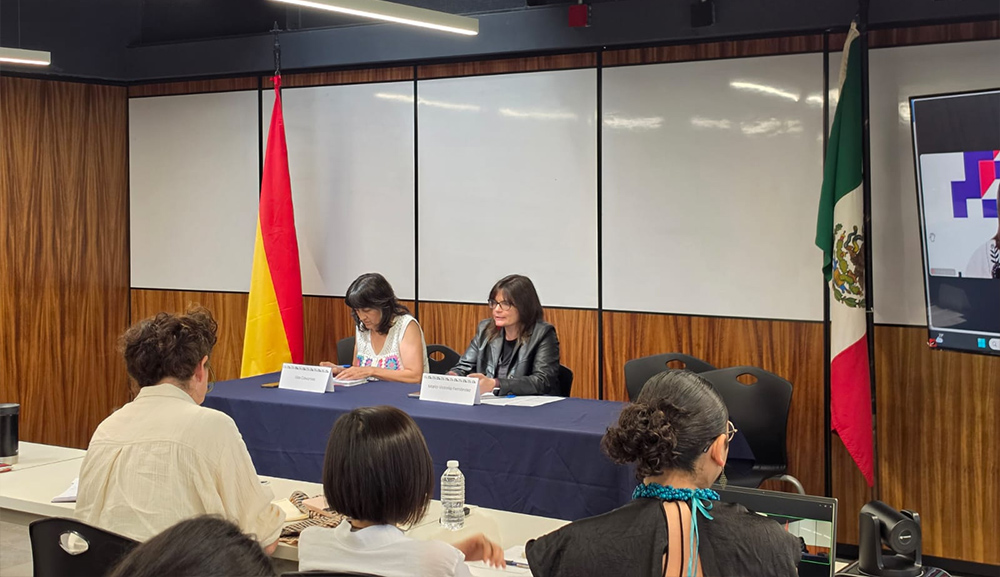
Dr. Ma. Victoria Fernández Molina moderated a panel on health, diets, and the right to food, highlighting the importance of strengthening public policies that ensure healthy, accessible, and culturally appropriate food.
Dr. María Victoria Fernández Molina, Coordinator of the Observatory on the Right to Food in Latin America and the Caribbean (ODA-ALC), Mexico Chapter, represented CADEBI at the RECEMX 2026 Sustainable Food Conference, held on October 15 and 16 at the UNAM University Extension Unit in Oaxaca de Juárez, Mexico.
Held under the theme “Combining Tradition and Innovation,” the event brought together experts from academic and scientific institutions, as well as civil society organizations, to reflect on the current challenges facing food systems and the opportunities to move toward healthier, more sustainable models that respect cultural and environmental diversity.
Throughout the conference, discussions addressed topics related to food history and traditional knowledge, health and diets, agrobiodiversity, food sovereignty, sustainable livestock farming, and emerging technologies applied to food production.
Representing CADEBI, Dr. María Victoria Fernández Molina coordinated and moderated the panel “Health, Diets, and the Right to Food,” featuring Mishel Unar Munguía, from the National Institute of Public Health (INSP), and Liza Covantes, from the Alliance for Food Health and the Parliamentary Front Against Hunger.
The panel provided an opportunity to reflect on the relationship between food, public health, and human rights, emphasizing the importance of understanding the right to food beyond mere food availability or the absence of hunger. From this perspective, discussions highlighted the need to guarantee adequate, healthy, sufficient, accessible, and culturally appropriate food, as well as to strengthen public policies and legal frameworks that ensure the effective realization of this right.
From a bioethical perspective, food-related challenges raise fundamental questions concerning human dignity, distributive justice, equitable access to resources, and responsibility toward future generations. The transformation of food systems cannot be assessed solely in terms of productivity, economic efficiency, or technological innovation. Rather, it requires ethical reflection on its consequences for the health of individuals, communities, territories, and the environment.
In this context, bioethics provides an interdisciplinary framework for examining the tensions among the various interests involved in food systems, while promoting decisions and public policies oriented toward the common good, the protection of vulnerable populations, and respect for cultural diversity.
CADEBI's participation in this event contributes to strengthening dialogue among bioethics, law, public health, and environmental sciences, as well as fostering collaboration among academic institutions and organizations committed to protecting human rights and promoting sustainability.
Furthermore, it reaffirms the importance of integrating bioethical reflection and a human rights-based approach into the analysis of contemporary food-related challenges, recognizing that food is not merely a basic necessity but also a fundamental right whose fulfillment is closely linked to human dignity, social justice, and collective responsibility.
More information:
Centro Anáhuac de Desarrollo Estratégico en Bioética (CADEBI)
Dr. Alejandro Sánchez Guerrero
alejandro.sanchezg@anahuac.mx