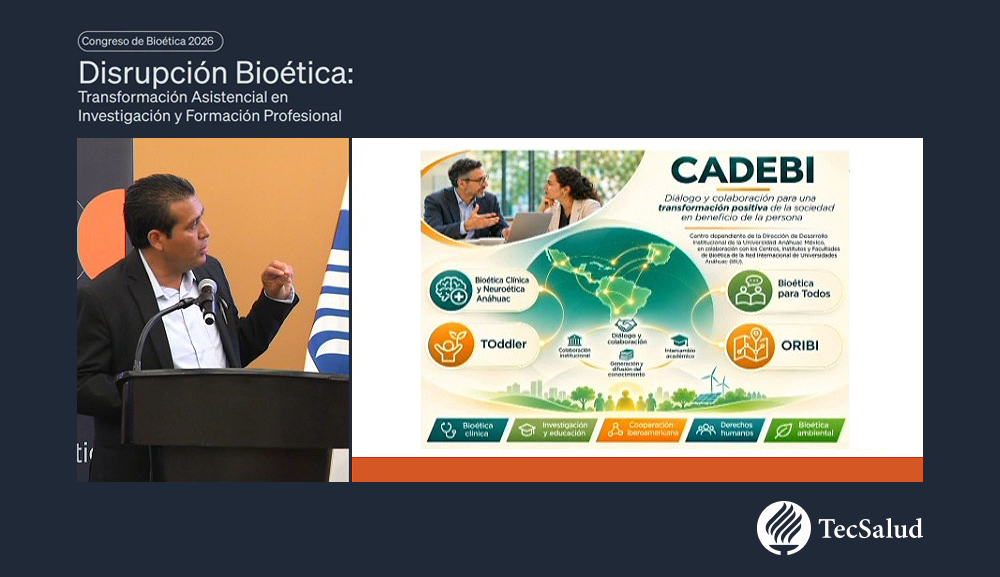
Dr. Alejandro Sánchez presented the progress of the Observatory of the Ibero-American Bioethics Network (ORIBI), an initiative of Universidad Anáhuac México that promotes education, institutional engagement, and academic cooperation across Ibero-America.
The Anáhuac Center for Strategic Development in Bioethics (CADEBI) participated in the International Bioethics Congress, organized by the School of Medicine and Health Sciences at Tecnológico de Monterrey, held on November 12–13, 2026, at the Zambrano Hellion Medical Center in Monterrey, Nuevo León, Mexico.
The event brought together specialists and healthcare professionals to reflect on contemporary bioethical challenges, addressing topics such as artificial intelligence governance in healthcare, the role of ethics committees, healthcare professionals’ well-being, innovations in bioethics education, and the ethical implications of advanced therapies.
During the free paper presentations session on November 13, Dr. Alejandro Sánchez Guerrero, Coordinator of CADEBI, delivered a presentation entitled “ORIBI: An Interactive Atlas to Strengthen Bioethics Education and Ibero-American Cooperation,” presenting the progress and key achievements of this strategic initiative.
In his presentation, he emphasized the development of the Ibero-American Interactive Bioethics Atlas as a digital platform that enables users to identify and access information on institutions, bioethics committees, academic programs, specialized publications, and other bioethics-related initiatives across the region. He also showcased its geographic and thematic search tools, institutional information update mechanisms, and features designed to facilitate communication and collaborative work among organizations.
Among the key achievements presented were the establishment of a network of collaborating institutions, the development of indicators to assess the advancement of bioethics in different countries, the systematic dissemination of academic activities, and the integration of an Ibero-American legal and regulatory repository. The latter facilitates comparative legal analysis and helps identify similarities, differences, regulatory gaps, and normative tensions associated with various bioethical issues.
The presentation also introduced the Atlas’s institutional participation mechanisms, which aim to foster knowledge exchange, continuous information updates, and the development of academic networks through specialized collaboration tools.
CADEBI’s participation provided an opportunity to share the progress of a project designed to address fragmented information and strengthen coordination among institutions dedicated to bioethics. In this context, ORIBI continues to establish itself as an initiative that seeks to transform available information into opportunities for research, education, and interinstitutional cooperation.
Through its participation in this academic event, Universidad Anáhuac México, through CADEBI, reaffirms its commitment to promoting a culture of bioethics grounded in human dignity, interdisciplinary dialogue, and international collaboration.
Explore the Ibero-American Interactive Bioethics Atlas: https://adam.anahuac.mx/ORIBI/#/
More information:
Centro Anáhuac de Desarrollo Estratégico en Bioética (CADEBI)
Dr. Alejandro Sánchez Guerrero
alejandro.sanchezg@anahuac.mx