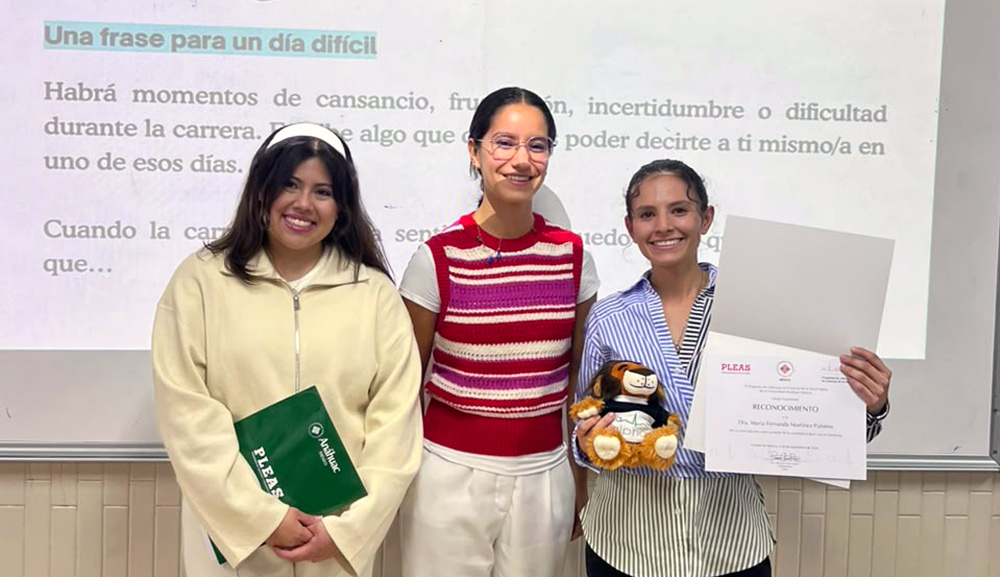
Dr. María Fernanda Martínez Palomo shared tools for recognizing, preventing, and coping with emotional exhaustion during training and practice in the health sciences.
As part of the collaboration between Clinical Bioethics and Neuroethics Anáhuac (BINCA) and Complejo QRS Alpha Sur, Dr. María Fernanda Martínez Palomo, BINCA Coordinator, led the session “Caring Without Burning Out: Burnout in Medicine,” a space dedicated to reflecting on mental health throughout healthcare education and professional practice. Drawing on her own experience, the session aimed to help participants understand what burnout can feel like, how to recognize its early manifestations, and which strategies can be incorporated to prevent and manage it. The central premise was clear: caring for mental health is not a secondary aspect of medical education, but rather an essential condition for providing appropriate patient care and building an ethical, humane, and sustainable professional practice.
Medical training is often characterized by high academic demands, significant responsibility, uncertainty, and constant exposure to emotionally challenging situations. However, learning to recognize the impact these experiences can have on those who provide care does not always receive the same attention within professional education. It was from this perspective that “Caring Without Burning Out: Burnout in Medicine” was developed as a collaborative session between Clinical Bioethics and Neuroethics Anáhuac (BINCA) and Complejo QRS Alpha Sur. Led by Dr. María Fernanda Martínez Palomo, BINCA Coordinator, the session addressed burnout through an approachable and preventive perspective, while also drawing on personal experience.
Rather than limiting the discussion to a definition of the syndrome, one of the session’s main objectives was to help participants understand what burnout can actually feel like in the daily life of a medical student or healthcare professional. Drawing on her own experience of living through burnout and learning how to manage it, Dr. Martínez Palomo shared a personal perspective on a process that does not necessarily emerge suddenly. It may begin with persistent fatigue, frustration, lack of motivation, or the feeling of no longer having sufficient energy to meet academic, professional, and personal demands.
The session explored the different ways in which prolonged stress may manifest. Emotional exhaustion may create the feeling that one’s resources have been depleted, while depersonalization may emerge as a form of emotional distancing in which patients gradually begin to be perceived more as cases, numbers, or diagnoses than as individuals. Burnout was presented as a condition associated with prolonged exposure to demands that, over time, exceed the resources available to cope with them.
One of the central messages was the importance of not normalizing suffering as an inevitable consequence of studying or practicing medicine. Burnout can manifest across different dimensions, ranging from irritability, frustration, anxiety, lack of motivation, and feelings of failure to difficulty concentrating, loss of interest in learning, sleep disturbances, persistent fatigue, headaches, and other physical symptoms. Recognizing these manifestations allows us to ask a simple yet fundamental question: How do I know when something is not right with me?
The discussion also broadened its focus to include anxiety, depression, and suicide risk, emphasizing the importance of recognizing warning signs such as sudden social withdrawal, extreme hopelessness, recurrent references to death, or statements about feeling like a burden. From this perspective, caring for one’s mental health does not mean expecting to feel well at all times. Rather, it means having the resources needed to cope with difficulties, adapt to change, maintain healthy relationships, make decisions, and find meaning in complex life experiences.
This reflection led to another essential question: What can we do before reaching the point of emotional exhaustion? Prevention was presented not as a single solution, but as the ongoing development of different self-care strategies. Among these, self-awareness was emphasized: learning to identify sources of stress, recognizing how we respond to them, and understanding our own limits. Equally important is building and relying on a support network, recognizing that no medical student or healthcare professional should have to face difficulties entirely alone. Family members, friends, professors, mentors, and mental health professionals can all serve as essential sources of support during particularly demanding periods.
The session also addressed practical preventive and self-care measures, including protecting sleep, maintaining regular physical activity, practicing mindfulness and present-moment awareness, and, importantly, seeking professional help when needed. Psychological or psychiatric support was presented not as a sign of weakness, but as a responsible act of self-care.
To move these concepts beyond theory, participants took part in a brief mindfulness and reflection exercise. For five minutes, they were invited to pause and connect with the present moment, and then reflect on how they recognize when they are approaching their limits, which personal needs they tend to overlook, what some of their main concerns regarding medical training currently are, and which aspects of these situations are genuinely within their control. The purpose was to create a moment of introspection within the session itself and to begin identifying personal strategies for navigating periods of increased pressure in healthier ways.
At the end of the activity, each participant kept the exercise as a personal resource to return to whenever needed, particularly during moments of exhaustion, frustration, uncertainty, or difficulty. The activity concluded with an invitation to write a personal phrase to remember on those days when the demands of medical training might make them feel that they can no longer keep going.
Through this collaboration, BINCA and Complejo QRS Alpha Sur created a different kind of space to discuss medical education—one in which knowledge, personal experience, and reflection came together to reinforce the idea that caring for others also requires learning how to care for ourselves. Discussing burnout through a relatable personal experience, learning to recognize its warning signs, and identifying tools to prevent and manage it can contribute to the development of healthcare professionals who are better prepared to face the demands of their vocation without accepting exhaustion as an inevitable part of it.
More information: https://www.anahuac.mx/mexico/CADEBI/en/clinical-bioethics-and-neuroethics-anahuac
More information:
Bioética Clínica y Neuroética Anáhuac (BINCA)
Dra. María Fernanda Martínez Palomo
neuroetica@anahuac.mx