The experience at the University of Arkansas for Medical Sciences provided firsthand insight into advances in structural cardiology and an opportunity to reflect on the importance of integrating scientific innovation with responsible, patient-centered medical care.
As part of his academic and professional training, Diego Aguirre Villegas, a medical student at Universidad Anáhuac México, completed an academic, clinical, and research obsevership in the Department of Cardiology at the University of Arkansas for Medical Sciences (UAMS) in Little Rock, Arkansas, United States, during the summer of 2026.
During this experience, he had the opportunity to work and learn alongside the UAMS Cardiology team under the mentorship of Dr. Srikanth Vallurupalli. His placement included participation in academic case-discussion sessions, activities in the inpatient service, and exposure to cardiovascular management in primary care in Batesville, Arkansas. He also attended a specialized session on atrial fibrillation led by Dr. Paydak.
One of the highlights of his placement was observing a transcatheter tricuspid valve replacement using the EVOQUE system from Edwards Lifesciences, performed by Drs. Srikanth Vallurupalli and Dr. Michael Luna. The procedure was particularly significant because it was the first implantation of this system via transjugular access at UAMS, offering an alternative to the conventional transfemoral approach.
During the intervention, Diego was able to observe firsthand how transesophageal echocardiography and fluoroscopy are integrated for anatomical visualization, device positioning, and real-time procedural guidance. He also received instruction in the principles of image acquisition and, under supervision, became familiar with handling the transesophageal echocardiography.
Beyond the technological advances he observed, the experience highlighted the interdisciplinary nature of highly specialized medicine. The coordinated involvement of interventional cardiologists, cardiovascular imaging specialists, anesthesiology professionals, nurses, and specialized technical personnel reflects the importance of teamwork in providing safe procedures tailored to each patient’s needs.
From a bioethical perspective, the introduction of new technologies into medical practice invites reflection on the responsibility that accompanies scientific progress. Innovation is not an end in itself: its value lies in its ability to contribute to people’s well-being, improve therapeutic options, and uphold patient dignity at the center of every clinical decision.
This perspective aligns with the emphasis that the Anáhuac Center for Strategic Development in Bioethics (CADEBI) places on examining the ethical challenges arising from scientific and technological development and professional practice, while promoting a holistic understanding of the person across the various areas of human care.
Diego’s experience at UAMS represents an opportunity for academic and personal growth, as well as firsthand exposure to the challenges facing contemporary medicine: integrating scientific knowledge, technological innovation, interdisciplinary collaboration, and ethical responsibility for the benefit of patients.
“Through international experiences such as this one, Universidad Anáhuac México continues to foster the development of professionals who understand that true progress in medicine depends not only on what technology makes possible, but also on the responsibility with which it is used in service of the person,” Diego emphasized.
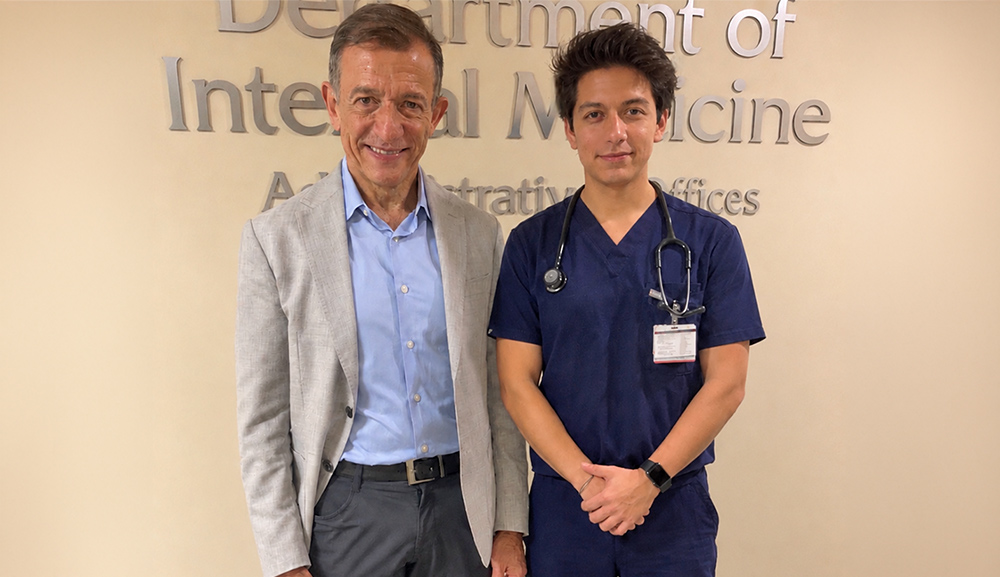
In the photo: Dr. Jorge Saucedo, Chief of Internal Medicine at the University of Arkansas for Medical Sciences, and Diego Aguirre Villegas.
More information:
Centro Anáhuac de Desarrollo Estratégico en Bioética (CADEBI)
Dr. Alejandro Sánchez Guerrero
alejandro.sanchezg@anahuac.mx