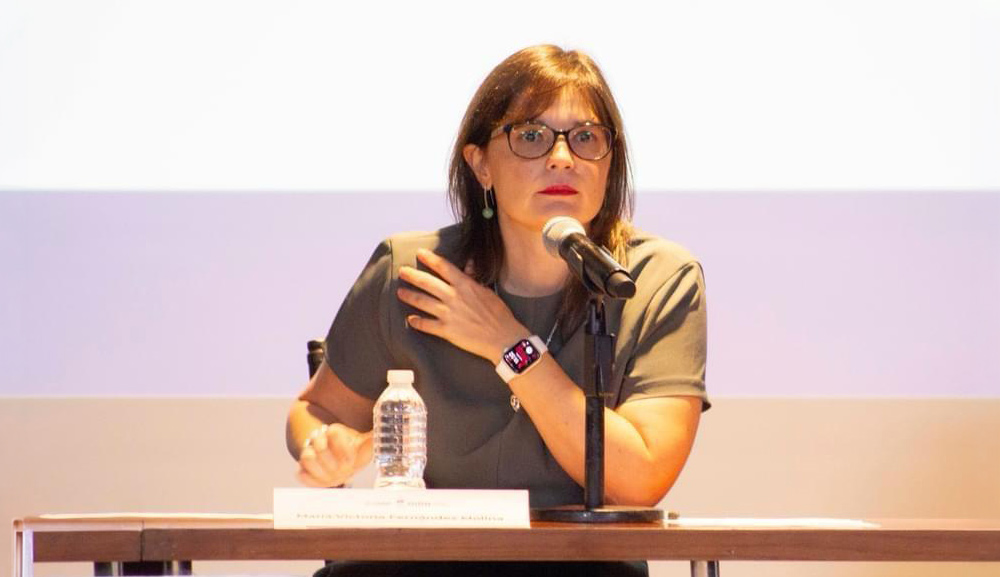
Dr. María Victoria Fernández explored food and eating from a bioethical perspective, questioning the extent to which our dietary choices are truly autonomous.
In a new edition of Food for the Brain, BINCA welcomed Dr. María Victoria Fernández, who explored food and eating from a bioethical perspective, questioning the extent to which our dietary choices are truly autonomous. Throughout the session, the cultural, social, economic, and environmental factors that shape what we eat were examined, along with dilemmas related to the right to food, justice, advertising, vulnerability, and both individual and collective responsibility.
Eating is one of the most ordinary decisions we make in our daily lives. We choose what to buy, what to prepare, and what to consume, seemingly according to our personal preferences. Yet behind each of these choices lies a complex network of factors that shape and constrain our possibilities. Taking this premise as a starting point, Dr. María Victoria Fernández presented a reflection at Food for the Brain entitled “What We Eat as a Bioethical Dilemma.”
The question “How much freedom do we truly have when it comes to what we eat?” emerged as one of the central themes of the discussion. Our culture, family and social environment, economic resources, food availability, and even environmental conditions all play a role in shaping our habits. Thinking about food autonomy therefore requires us to move beyond the notion that each individual simply “chooses what to eat” and to recognize that the capacity to choose is not equally available to everyone.
This perspective inevitably leads to the issue of food justice. The right to adequate food extends beyond the mere availability of food and calls for reflection on the conditions that enable people to access it with dignity. Who is able to choose? What options are available to them? Who is excluded from certain food systems? These questions shift the discussion away from an exclusively individual understanding of responsibility and toward the social and structural conditions that also shape our consumption patterns.
A particularly relevant point was the role of advertising and the food industry. If our preferences can be influenced by commercial strategies and by the environments in which we make our food choices, autonomy takes on additional complexity. The dilemma becomes even more significant when considering children and other vulnerable populations, as it requires striking a balance between freedom, protection, and responsibility.
However, the ethical implications of food do not end with the consumer. Every choice participates, in one way or another, in a broader chain of production. What we eat also influences what is produced and how it is produced. Our decisions can therefore have consequences that extend to the environment, the use of natural resources, and the communities involved in food systems.
From the perspective of integral ecology, the session highlighted that human health, food, society, and the environment cannot be understood in isolation. What appears on our plates is part of a much larger system, and responsibility for food therefore encompasses both personal and collective dimensions.
Viewing food through the lens of bioethics transforms an apparently simple everyday action into a series of fundamental questions: Do we truly choose what we eat? What conditions make that choice possible? What responsibilities do we have toward those with fewer alternatives? And what impact do our decisions have beyond ourselves?
Through the exchange of ideas and examples, the conversation underscored that promoting more conscious food choices does not mean placing the entire burden of responsibility on the individual. Rather, it requires understanding the interaction between autonomy, vulnerability, justice, and shared responsibility. In this way, Food for the Brain provided a space to reconsider our relationship with food and to recognize that what we place on our tables each day can itself become a profoundly bioethical question.

More information: BINCA
Más información:
Bioética Clínica y Neuroética Anáhuac (BINCA)
Dra. María Fernanda Martínez Palomo
neuroetica@anahuac.mx