January 13, 2026
Author: Ana Corina Ballout Hernández
Versión en español
Introduction
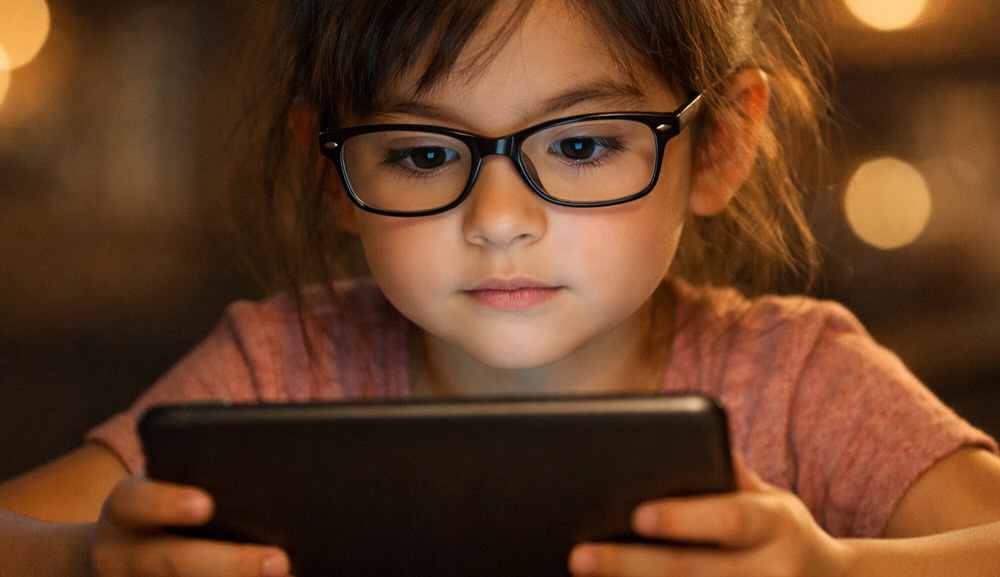
Childhood myopia is increasing at a pace that forces us to look beyond the clinical setting. It is not only an issue of eyeglasses; it is a visible effect of school, urban, and digital lifestyles. If we want to protect future visual health, we need practical prevention and shared responsibility among families, schools, and public policies.
Development
What is at stake when a child becomes myopic?
Myopia is the difficulty in seeing clearly at a distance and is commonly associated with excessive growth of the eyeball. When it progresses to high myopia, the risk of complications such as cataract, glaucoma, retinal detachment, and macular damage increases, with potential visual loss in adulthood (Grzybowski et al., 2020; Liang et al., 2025). In simple terms: it is not just “wearing glasses”; it is reducing the risk of future ocular disease.
Why does it seem to be increasing so quickly?
Childhood myopia appears to be rising rapidly due to a combination of global trends and lifestyle changes. The most recent evidence suggests that nearly one-third of children and adolescents already live with myopia, and that global prevalence has grown steadily in recent decades. In a broad synthesis, Liang and collaborators (2025) report that combined prevalence rose from 24.32% between 1990–2000 to 35.81% between 2020–2023, with projections of an even greater burden by 2050. Although genetic predisposition and family history play a role, the speed and magnitude of this increase point to a decisive role for environmental and behavioral factors, such as increased near visual work and reduced outdoor time (Grzybowski et al., 2020; Liang et al., 2025).
Are screens the main villain?
Screens do not act alone, but they are part of the problem. A meta-analysis with dose–response evaluation found that every extra hour of screen time per day was associated with a 21% higher likelihood of myopia (Ha et al., 2025). The increase in risk became clearer when screen time exceeded one hour per day, and the relationship was stronger between one and four hours daily. Consistently, Zong et al. (2024) also reported a general association between screen time and myopia in children and adolescents. Even so, reducing the matter to “screens yes/screens no” would be insufficient. The evidence suggests that the underlying issue is excessive near visual work without breaks, such as long school assignments, prolonged reading, computer use, and digital entertainment that ultimately displace outdoor time (Iyer et al., 2025). This weighs more heavily in urban and academically demanding contexts, where children spend most of the day indoors.
The bioethical question therefore shifts: Are we asking families to solve a risk that is also produced at school and in the city?
Is there a “reasonable limit” for daily life?
The evidence does not yet allow for a single rule for all families, but it does provide practical guidance. In general, less screen time in early ages, avoiding long periods without breaks, and balancing digital activities with physical and social activities may help reduce cumulative myopia risk (Ha et al., 2025; Iyer et al., 2025). In line with this, some public health recommendations suggest short and frequent breaks during near work; a simple guideline is to look into the distance for about 20 seconds every 20 minutes (Iyer et al., 2025).
What can we do that is realistic and equitable?
The strongest and easiest intervention to implement is increasing outdoor time. A meta-analysis of randomized clinical trials found that more outdoor exposure reduces the incidence of myopia and also decreases signs of progression, such as axial eye elongation (Mei et al., 2024). For this reason, various reviews and editorials agree that aiming for around two hours of outdoor time per day is a reasonable preventive goal in childhood (Iyer et al., 2025; Mei et al., 2024).
And it is not just about “more sun.” Intense outdoor light is associated with retinal signaling that slows excessive eye growth, while indoor environments offer lower light intensity and encourage more continuous near work (Grzybowski et al., 2020).
Micro-actions at home
Prioritize outdoor play after school.
Take frequent breaks during near tasks.
Maintain good lighting and adequate reading distance.
Reserve recreational screen use for limited periods. Alternate digital study with physical activities.
Micro-actions at school
Protect longer, active outdoor recesses.
Reinforce basic visual hygiene in the classroom (breaks and distance).
Avoid relying exclusively on screens for assignments.
Maintain classrooms with adequate lighting.
Train teachers to identify early signs of visual fatigue.
Micro-actions in the city
Promote nearby, accessible, and safe parks.
Support community programs for children’s play and sports.
Design urban environments that facilitate being outdoors.
These levels matter because prevention cannot fall solely on individual decisions. Asking for “less screen time” without offering real alternatives can make the recommendation unfair and difficult to follow for families living in resource-limited contexts.
And what about medical treatment?
In children with rapid progression or high family risk, clinical treatment may be a good complement to daily prevention. Topical atropine has shown favorable evidence in slowing progression in selected cases with specialized follow-up (Li et al., 2024). There are also lenses for myopia control and, in indicated situations, orthokeratology. These options must be individualized and do not replace fundamental measures: more outdoor time and less continuous near work (Grzybowski et al., 2020; Mei et al., 2024).
Conclusions
Childhood myopia is a public health challenge and a current bioethical dilemma because it reflects collective decisions about how we educate, how we design our cities, and how we use technology. The evidence indicates that the increase in recent decades cannot be explained by genetics alone: screen time and, above all, excessive continuous near work appear to contribute substantially to risk (Ha et al., 2025; Iyer et al., 2025; Liang et al., 2025).
The most ethical and effective response combines daily behavioral changes with environmental decisions. At home, it is about balancing screen use with simple visual hygiene habits and more outdoor time. At school, it is essential to protect ample recess and avoid routines that turn near work into a continuous, break-free day. And in the city, having safe spaces for outdoor play—far from being a luxury—is a preventive necessity with real impact on visual health and social well-being (Mei et al., 2024).
We must also be mindful of the public language we use to address the problem. The narrative of “irresponsible parents” or “kids addicted to screens” is unhelpful when the school, urban, and technological context pushes children to spend hours indoors. Instead of placing blame, the conversation should highlight shared responsibility: families, schools, sports clubs, local authorities, and health professionals contribute different pieces of the same puzzle.
Digital childhood is here to stay. The question is not whether we should use technology, but how to ensure that its use does not compromise visual development. If we manage to integrate reasonable exposure limits, consistent breaks, and a daily minimum of outdoor life, we will be able to contain the trend and make prevention an act of collective care.
Referencias (APA 7)
Grzybowski, A., Kanclerz, P., Tsubota, K., Lanca, C., & Saw, S.-M. (2020). A review on the epidemiology of myopia in school children worldwide. BMC Ophthalmology, 20, 27.
Ha, A., Lee, Y. J., Lee, M., Shim, S. R., & Kim, Y. K. (2025). Digital screen time and myopia: A systematic review and dose-response meta-analysis. JAMA Network Open, 8(2), e2460026. I
yer, V., Martin, D., & Reijneveld, S. A. (2025). Myopia and screen time in children: Epidemic proportions. European Journal of Public Health, 35(5), 809–810.
Li, Y., Yip, M., Ning, Y., et al. (2024). Topical atropine for childhood myopia control: The Atropine Treatment Long-Term Assessment Study. JAMA Ophthalmology, 142(1), 15–23.
Liang, J., Pu, Y., Chen, J., et al. (2025). Global prevalence, trend and projection of myopia in children and adolescents from 1990 to 2050: A comprehensive systematic review and meta-analysis. British Journal of Ophthalmology, 109, 362–371.
Mei, Z., Zhang, Y., Jiang, W., Lam, C., Luo, S., Cai, C., & Luo, S. (2024). Efficacy of outdoor interventions for myopia in children and adolescents: A systematic review and meta-analysis of randomized controlled trials. Frontiers in Public Health, 12, 1452567.
Zong, Z., Zhang, Y., Qiao, J., Tian, Y., & Xu, S. (2024). The association between screen time exposure and myopia in children and adolescents: A meta-analysis. BMC Public Health, 24, 1625.
Ana Corina Ballout Hernández is a graduate of Medicine from Universidad Anáhuac México Norte, with a particular interest in ophthalmology and medical bioethics. She is currently completing her social service at CADEBI, where she actively participates in all projects that integrate clinical ethics with academic and public health initiatives. Her long-term goal is to specialize in ophthalmology and later subspecialize in anterior segment surgery. This article was assisted in its drafting by the use of ChatGPT, an artificial intelligence tool developed by OpenAI.
The opinions expressed in this blog are the sole responsibility of its authors and do not necessarily represent the official position of CADEBI. As an institution committed to inclusion and plural dialogue, CADEBI promotes and disseminates a diversity of voices and approaches, with the conviction that respectful and critical exchange enriches our academic and educational work. We value and encourage all comments, responses, or constructive critiques you may wish to share.
More information:
Centro Anáhuac de Desarrollo Estratégico en Bioética (CADEBI)
Dr. Alejandro Sánchez Guerrero
alejandro.sanchezg@anahuac.mx